
The Hunt Saboteurs Association has produced a booklet titled ‘Witness The End Of Hunting’ which outlines our plans to stop hunters in their tracks or – at least – get them into court with a high chance of prosecution.
In this fourth article, the HSA looks at our proposal to remove all exemptions to the Hunting Act. The many hunting exemptions were squeezed into the original act to allow for many practices, the majority having nothing to do with hunting to hounds.

The reasons given for this exemption is to allow acts to prevent damage to livestock, growing timber, etc. There is no reason why the flushing of animals cannot be done by humans making noise, and as such there is no need to allow this exemption to use dogs for such purposes.
There is, of course, no reason to introduce dogs (terriers) to earths during a hunt following a trail, although the evidence shows this is a frequent occurrence. Introducing dogs to an animal’s earth or sett to kill or force it to move on has no relation to hunting with hounds and causes suffering to both the dogs involved and the hunted mammal. In most instances, it would be illegal under current legislation.
Introducing a terrier to an earth often causes the terrier and the hunted animal to become trapped underground, forcing the owner to dig into the earth to retrieve both animals. Destroying the habitat of indigenous mammals is not required and is an overreaction to the small amount of predation foxes cause. It needs to be restated that, depending on location, the vast majority of a fox’s diet is rabbits, slugs, carrion and fruit.

Despite the exemption for rats, there have been convictions under the Hunting Act in 2007 for the setting of dogs onto rats on private land. There are numerous ways of dealing with issues of rats on your property which do not involve setting a large number of dogs to hunt them, making this exemption superfluous to the Act.

As with rats, there have been convictions under the Act for hunting rabbits on land without permission. Again, issues with rabbits do not have to be dealt with by setting dogs onto them, and it is, at best, an impractical solution.
In a paper published in the European Journal of Wildlife Research 2011, Bryony Tolhurst at Sussex University and her colleagues presented their findings on foxes visiting farm buildings. Tolhurst and her colleagues analysed video and still footage from 422 separate visits and observed that the foxes rarely ate the animal feed (although they frequently scent-marked it); instead, the biologists noted frequent pouncing behaviour, suggesting that the foxes were visiting the buildings to hunt rodents. Scottish naturalist James Lockie estimated that a fox could eat at least a thousand voles each winter, saving the farmer a potential 10.5kg (23 lbs) of grass (i.e. sheep/cattle food). Beagle packs frequently claim to be hunting rabbits as a cover for their illegal hare hunting.
This exemption is in relation purely to a hare which has been shot on the owner’s land. Beagle packs occasionally use this exemption as cover for illegal hare hunting.
In official falconry, there are generally two types of use, and these will depend on the bird used.
The first use is falconry with ‘long wings’ (peregrine falcons, or similar hunting grouse, duck, etc) who will often use pointers that will find the quarry bird and freeze (point at it). These can then be flushed to the falcon, which will already be flying high above and allowed to stoop on the prey.
The second type involves someone flying a goshawk or similar ‘short wing’ which is generally flown from the fist with a pursuit flight of the quarry at a low level after being flushed by something like a spaniel. Short wings will hunt anything flushed, like rabbits, hares (if the bird is large enough), pheasants, partridges, etc.
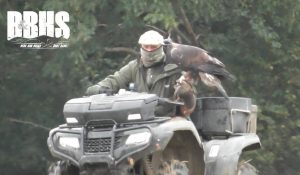
In reality, birds of prey in the UK do not attack adult foxes, which are large and dangerous as prey. The exception would be Golden eagles, mainly used in the USA.
The Hawk Board, falconry’s governing body, which has strong links with the Countryside Alliance, state that foxes are not a recognised quarry, due to quarry and bird welfare issues, plus they also state they shouldn’t be used with packs of hounds.
There is no reason to link falconry, which requires a license, to hunting with hounds, which does not. The license requires any activities taken on land to be with the owner’s permission and only for sporting purposes. With the above changes to the Act, flushing animals to a bird of prey by a pack of hounds would already be illegal, so this exemption is not required.

Organisations such as the RSPCA do not use dogs to capture wild mammals. Nets and traps are the preferred methods, as using a dog would only serve to chase the animal away and cause considerable distress to the hunted animal, injured or otherwise.
As in recapture, the rescue of an injured mammal is done by reputable organisations using noose poles, nets or humane traps.

Since 2004, this exemption has only been used in court cases related to stag or deer hunting.
The only published study since 2004 is ‘A study of the incidence of bovine tuberculosis in the wild red deer herd of Exmoor’ by Keith J. Collard17. The blood samples collected have been taken once the prey has been shot, after being hunted by hounds.
This study ended in 2022, and we can find no evidence of current studies. This study states that no deer were culled explicitly for this project, which logically would mean that the killing of the mammals then breached the Act, as the hunting involved was not for observation or research.
To date, we can find no evidence of the process used in collecting the blood for the study apart from the links to hunts, so how varied and random the collection is is under question.
Regardless, this type of research could be carried out using other methods that do not involve hunting and killing the subject animal.
This fact alone shows that a single study has been done in over 20 years, and that, similar to ‘trail hunting’, a cynical exploitation of the exemption to continue the practice of stag hunting.